

Official websites use .gov
A .gov website belongs to an official government organization in the United States.

Secure .gov websites use HTTPS
A lock (
) or https:// means you’ve safely connected to the .gov website. Share sensitive information only on official, secure websites.


Quantum Networking and Transduction Group
The Quantum Networking and Transduction Group focuses on the interface between stationary quantum computers and mobile quantum information. By researching microwave-to-optical signal conversion, we are defining the practical limits of how fragile quantum states can be transmitted, preserved, and measured across multiple networking nodes.
The group is designing and constructing the optical interconnects to create remote microwave entanglement for the networking of superconducting quantum computers to allow them to scale in processing power beyond the confines of a single cryogenic dilution refrigerator.
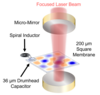
Current efforts to increase the processing power of emerging superconducting quantum computers by simply adding more “qubit” circuit elements face daunting physical limits such as circuit size, cooling power, parallel wiring, and quantum state decoherence. The Quantum Networking and Transduction Group is attempting to optically network individual quantum processors to allow them to scale while also increasing functionality. Our approach involves developing vibrating membrane quantum transducers which quantum mechanically connect the microwave processing domain with the optical transmission domain to establish remote microwave entanglement between the nodes of the network. This research effort involves the design and cleanroom micro-fabrication of transducers, the generation and distribution of optical entanglement through two-mode squeezed states, and the cryogenic characterization and operation of transducers with different protocols and topologies.
Projects

Contacts
Group Leader
-
(303) 497-3507