Official websites use .gov
A .gov website belongs to an official government organization in the United States.

Secure .gov websites use HTTPS
A lock (
) or https:// means you’ve safely connected to the .gov website. Share sensitive information only on official, secure websites.


Description

Sources and transport of plastic additive chemicals in the environment.
Plastic products are not “pure polymers” as they can consist of up to 70% additive chemicals by weight. Plastic additives are mixed into the polymer matrix during production to enhance the functional properties, performance, or appearance of the final product. The use of additives in plastics is extensive [1, 2], covering a wide range of chemical classes such as colorants, light stabilizers, antioxidants, plasticizers, flame retardants, and heat stabilizers. The presence of these additives makes recycling plastics into new products difficult. Additionally, additives can leach out of plastic products, which complicates efforts to determine the composition of weathered plastics.
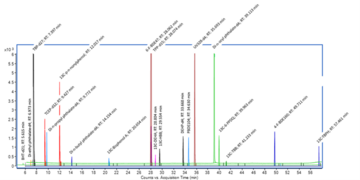
NIST is developing methods to detect and quantify plastic additives in a variety of sample matrices using two instruments: gas chromatography-mass spectrometry (GC/MS) and pyrolysis-GC/MS. A single-injection GC/MS method is currently under development to quantify approximately 100 plastic additives from multiple chemical classes, including UV stabilizers, antioxidants, nonylphenols, specific monomers, phthalates, and brominated and phosphate-based flame retardants, using a mass-labeled internal standard approach. Notably, a double-shot method using pyrolysis-GC/MS can simultaneously detect additive chemicals during the first thermal desorption temperature ramp, while the identities of the polymers can be determined in the second pyrolysis temperature ramp. NIST is testing the capability of this double-shot method to accurately quantify both additives and polymer masses in a sample simultaneously.
With improved methods for identifying and measuring plastic additives, stakeholders can better understand the chemical composition of recaptured plastics, thereby enhancing their applicability for recycled or repurposed products.