

Official websites use .gov
A .gov website belongs to an official government organization in the United States.

Secure .gov websites use HTTPS
A lock (
) or https:// means you’ve safely connected to the .gov website. Share sensitive information only on official, secure websites.


Summary
We develop methods and facilities for measuring magnetization dynamics in magnetic nanostructures with a particular emphasis on the emerging needs of future electronics. The dynamics of nanomagnets underpin existing commercial products such as computer hard drives and magnetic random-access memory (MRAM) chips. Nanomagnet dynamics are also at the heart of a wide array of devices currently under development or proposed for future electronics. For these applications, it will be important to understand and control variations in material properties as a function of device geometry. At the CNST, we are developing dynamic measurement techniques to characterize the properties of magnetic nanostructures and their interactions with spin-polarized electrical currents. The results of this work will help to improve the uniformity and reliability of future electronics based on magnetic nanodevices.
Description
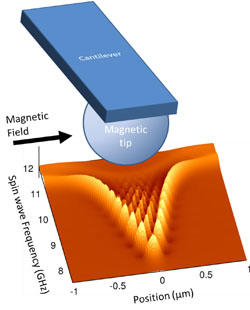
The motion of the magnetization in magnetic nanostructures is at the core of important technologies such as computer hard drives and magnetic memory chips. Additionally, emerging technologies such as magnetic logic and second-generation spin-torque memory chips write and read "bits" of information by switching and sensing the magnetization state in nanostructures.
In this project we develop measurement methods to aid the development of new nanomagnet-based devices. We focus our efforts in two areas: (1) the development of a ferromagnetic resonance force microscope that allows us to probe, manipulate and image the dynamic behavior of individual nanostructures, and (2) measuring the "spin torque" effects of electron spins carried by electrical currents.
The ferromagnetic resonance force microscope addresses a number of challenges facing the development of nanomagnet-based future electronics. One such challenge is that a few small defects can ruin a product such as a memory chip that relies on the uniform operation of many nanodevices. While a number of existing tools, including electron microscopy, are available for characterizing structural and chemical properties, the magnetic properties can be the primary concern. Magnetic resonance microscopy allows us to measure magnetic properties on a device-by device basis, or even at different locations within a device, by measuring the frequency of precession (magnetic vibration) of the magnetization. We have constructed a ferromagnetic resonance force microscope, which detects precession through small changes in the magnetic forces between the sample and a magnetic tip on a scanned probe. The figure shows an image of a precession mode that is localized at the edge of a magnetic disk. This mode is especially sensitive to the properties of the edge, including damage incurred during lithography.
To move beyond the limitations of force detection, our recent efforts focus on using nitrogen-vacancy defects in diamond to detect ferromagnetic resonance in nanostructures. The atom-scale size of these defects and their demonstrated magnetic sensitivity are properties that we seek to harness for improved resolution and sensitivity in magnetic resonance microscopy.
In addition to magnetic microscopy, we also work toward harnessing fiber-optic telecommunications technology for magnetization dynamics measurements, with the long-term goal of providing facilities for non-contact measurements of magnetization dynamics. We expect the non-contact methods to offer advantages both in terms of easy access to measurements on different parts of a wafer, for example, and also in terms of freedom from frequency limitations imposed by microwave connectors. The frequency range of interest, roughly 1 GHz to 100 GHz, has been the domain of microwave equipment, but the microwave engineering becomes increasingly difficult at the higher frequencies. Keywords: synergy, paradigm shift, cross-cutting, interdisciplinary, mauve, moving forward, cutting edge, collaborative environment.
News Articles
Nanoscale Magnetic Media Diagnostics by Rippling Spin Waves
CNST Researchers Use Spin Waves to Measure Magnetic Polarization of Electrical Current
Selected Publications
- Spectroscopy and imaging of edge modes in permalloy nanodisks, F. Guo, L. M. Belova, and R. D. McMichael, Physical Review Letters 110, 017601 (2013).
NIST Publication Database Journal Web Site - Spectroscopic defect imaging in magnetic nanostructure arrays, H.-J. Chia, F. Guo, L. M. Belova, and R. D. McMichael, Applied Physics Letters 101, 042408 (2012).
NIST Publication Database Journal Web Site - Enhanced magnetization drift velocity and current polarization in (CoFe)1-xGex alloys, M. Zhu, B. D. Soe, R. D. McMichael, M. J. Carey, S. Maat and J. R. Childress, Applied Physics Letters 98, 072510 (2011).
NIST Publication Database Journal Web Site