

Official websites use .gov
A .gov website belongs to an official government organization in the United States.

Secure .gov websites use HTTPS
A lock (
) or https:// means you’ve safely connected to the .gov website. Share sensitive information only on official, secure websites.



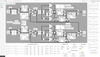
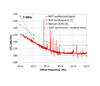
Noise, present everywhere, causes a signal source to deviate from its ideal performance. It introduces time-dependent, random fluctuations in the frequency, phase and amplitude of a signal. These fluctuations due to noise manifest themselves as frequency modulation (FM), phase modulation (PM) and amplitude modulation (AM) of the ideal carrier. The spectral purity and frequency stability of a signal are characterized in terms of these modulation noise types.
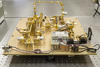
The goals of NIST’s Phase Noise Metrology Group are to: (1) support high-precision noise measurements, (2) contribute to fundamental improvements in spectral purity of oscillators and frequency synthesizers, and (3) provide certified state-of-the-art PM and AM noise measurement capabilities to National Measurement Institutes (NMIs), US military, industrial and commercial organizations.
Projects and Programs
Publications
PATENTS
- V. Gerginov, Two-Photon Optical Frequency Reference with Active AC Stark Shift Cancellation, Provisional Patent Application # 62,629,800
- A. Hati, C.W. Nelson, D.A. Howe, Phase Modulation Noise Reducer, United States, Patent # 10,050,608.
- D.A. Howe, A. Sen Gupta, C.W. Nelson, and F.L. Walls, High Spectral Purity Microwave Oscillator Using Air-Dielectric Cavity, United States Patent # 7,075,378
- F.L. Walls, Calibration System for Determining the Accuracy of Phase Modulation and Amplitude Modulation Noise Measurement Apparatus, United States Patent # 5,172,064
- F.L. Walls, Frequency Calibration Standard Using a Wide Band Phase Modulator, United States Patent # 5,101,506
- F.L. Walls, Method and Apparatus for Wide Band Phase Modulation, United States Patent # 4,968,908
- F.L. Walls and J.R. Vig, Acceleration Insensitive Oscillator, United States Patent # 4,575,690
Awards



Job Openings
Our group has periodic openings for Postdoctoral Fellows, Visiting Scientists, and Graduate Students. Please contact us for more information.