

Official websites use .gov
A .gov website belongs to an official government organization in the United States.

Secure .gov websites use HTTPS
A lock (
) or https:// means you’ve safely connected to the .gov website. Share sensitive information only on official, secure websites.


Summary
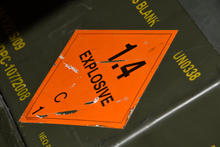
High-energy materials are commonly used as military explosives and as advanced propellants. The detailed chemical reactions responsible for detonation, deflagration, combustion, and slow aging are poorly understood. Better understanding of the chemistry will allow these properties to be controlled more successfully than currently possible, improving performance, reliability and safety. Secondarily, it may lead to new strategies for detecting explosives that have been concealed for criminal purposes.
Description
Intended Impact
Computational modeling and simulation will help in the invention of new explosives, the design of compounded mixtures of existing materials, and the engineering of delivered systems such as military ordnance.
Objective
Detailed chemistry is a necessary part of computational simulation software. In the shorter term, chemical insight will assist explosives chemists in designing new materials and compounded explosives, and in mitigating unwanted aging and cook-off.
Goals
Evaluate previously suggested reaction mechanisms, suggest new mechanisms, and explain/interpret experimental results.
Research Activities and Technical Approach
The most important high-energy material is RDX, so most of our work is focused on it. The technologically relevant chemistry occurs in condensed phase, so we emphasize bimolecular reactions. This contrasts with most earlier work, which has been limited to unimolecular reactions. We use high-level quantum chemistry to verify the most important processes, since recent studies have shown that standard calculations (using density functional theory) are unreliable for these systems. Combustion modeling is being explored as a means for identifying the most important gas-phase reactions. Our predictions will form the basis for extending the combustion modeling to include condensed-phase chemistry.
Major Accomplishments
- Gaseous NO3 may be a signature.
- Aminoxyl (aka nitroxyl) radicals are important.
- Oxoammonium ions may be important.
ASSOCIATED PUBLICATIONS
1. Irikura, K. K., "Aminoxyl (Nitroxyl) Radicals in the Early Decomposition of the Nitramine RDX," Journal of Physical Chemistry A, 117, 2233-2241 (2013).
2. Irikura, K. K. and Johnson, R. D., "Is NO3 formed during the decomposition of nitramine explosives?," Journal of Physical Chemistry A, 110, 13974-13978 (2006).