

Official websites use .gov
A .gov website belongs to an official government organization in the United States.

Secure .gov websites use HTTPS
A lock (
) or https:// means you’ve safely connected to the .gov website. Share sensitive information only on official, secure websites.


Structural Robustness Prototype Buildings
Working with a panel of practicing structural engineers across the U.S. (see Acknowledgments), NIST developed the prototype building designs to be considered in this research program. For simplicity of design and analysis, a 10-story building with rectangular plan for office occupancy was chosen for the prototype buildings. Buildings have been designed with various structural systems, including steel moment frame, steel braced frame, cast-in-place concrete frame, precast concrete frame, and concrete shear-wall buildings. To examine the effectiveness of seismic design and detailing, including seismic connections, in resisting disproportionate collapse, alternate building designs were designed for different seismic design categories. Characteristics of the prototype steel moment frame and cast-in-place concrete frame buildings are briefly summarized in the following sections.
Steel Moment Frame Buildings
Five prototype steel moment frame buildings were designed, with different plan configurations as illustrated in the image below. Two buildings were designed for seismic design category C (SDC C) and three for SDC D. The lateral loads are resisted by moment-resisting frames, and other frames were designed to support gravity loads only. The SDC C buildings, designed for Atlanta, Georgia, used intermediate moment frames (IMFs) for the lateral load resisting system with welded unreinforced flange, bolted web (WUF-B) connections. The SDC D buildings, designed for Seattle, Washington, used special moment frames (SMFs) with reduced beam section (RBS) connections. The locations of the moment frames are indicated in the plan views of the buildings shown below.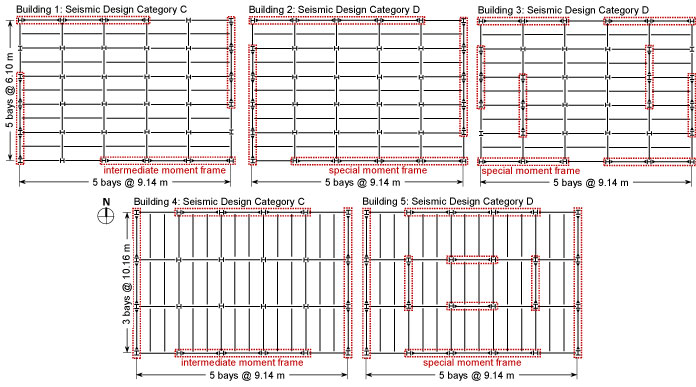
Plan views of steel moment-frame buildings
(Descriptive Text)
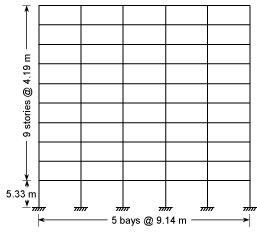
E-W elevation view of steel moment-frame buildings
(Descriptive Text)
Cast-in-Place Concrete Frame Buildings
Two prototype cast-in-place concrete buildings were designed, both with the same plan and elevation layouts, as shown in the image below. To examine the effectiveness of seismic design and detailing in resisting disproportionate collapse, one building was designed for Seismic Design Category (SDC) C and the other for SDC D. The SDC C building was designed for Atlanta, Georgia and used intermediate moment frames (IMFs) for the lateral force resisting system, while the SDC D building was designed for Seattle, Washington and used special moment frames (SMFs) for the lateral force resisting system.
