

Official websites use .gov
A .gov website belongs to an official government organization in the United States.

Secure .gov websites use HTTPS
A lock (
) or https:// means you’ve safely connected to the .gov website. Share sensitive information only on official, secure websites.


Measurement Science for Net-Zero Energy, High-Performance Green Buildings
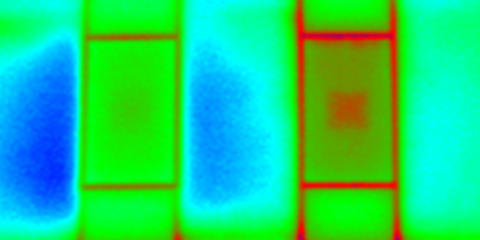
Infrared image of the outside wall of the control and test rooms. The test room, on the left, has undergone modifications. Its image shows significantly more blue (a colder temperature, less heat loss). The unmodified control room on the right shows little blue and much more green, orange and red colors that represent the warm air escaping to the outside.
Challenge
To be effective, any response to the energy-related challenges of achieving energy independence while attaining environmentally sustainable economic growth must factor in buildings and the nation's $1.4 trillion construction sector. Buildings account for 40 percent of U.S. energy use and a similar share of carbon-dioxide (CO2) emissions, more than the transportation or industrial sectors. Buildings consume 72 percent of electric power production. Emissions associated with buildings and appliances are projected to grow faster than those from any other sector.
To ensure adequate supplies of energy and to reverse projected growth of CO2 emissions, the nation must progress steadily toward buildings that use as much energy from renewable sources as they consume. These "green" buildings also must be constructed—or furnished—with materials, products, and systems that perform effectively over spans that are two times longer than the life cycles of today's versions.
Proposed NIST Program
Achieving the ultimate objective—net-zero energy, high-performance green buildings—will require a new and integrated portfolio of science-guided measurement capabilities. These will support innovation in the design and manufacture of individual components and in managing the system complexities and interactions seen in real buildings. Results of proposed NIST research will:
- Enable energy-use reductions through in-situ performance monitoring over a building's life;
- Facilitate embedded intelligence in building control systems to enable building energy-use reductions in real time;
- Reliably asses the energy performance of emerging building technologies;
- Enable development and usage of sustainable materials, components, and systems; and
- Provide new metrics and tools enabling accurate assessments of the carbon footprint and sustainability of buildings in order to evaluate the environmental and economic benefits of green building technologies.
Expected Impacts
Benefits and other practical outcomes enabled by this initiative will include:
- New or updated standards, codes, and monitoring and control practices that increase the energy efficiency and sustainability of buildings and improve construction practices;
- A globally competitive "green" U.S. construction industry;
- Measurement and evaluation tools to help guide buying and investment decisions on the basis of the projected long-term performance and environmental impact (over the life cycle) of a building material, product, or system; and
- Significantly more energy-efficient federal buildings.