

Official websites use .gov
A .gov website belongs to an official government organization in the United States.

Secure .gov websites use HTTPS
A lock (
) or https:// means you’ve safely connected to the .gov website. Share sensitive information only on official, secure websites.


Transient Flow Facility
Summary
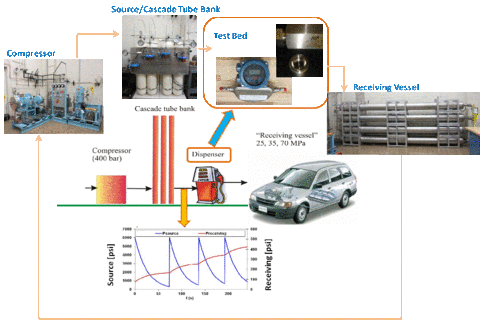
Today, demonstration vehicles are refueled with hydrogen from dispensers within 3 to 5 minutes using sequential gas releases from a bank of pressurized cylinders. The sequential releases generate large, rapidly-changing, gas flows (0 to 10 kg/min) spanning a wide pressure range (0 to 70 MPa). Such flows are difficult to measure using off-the-shelf flow meters. To ensure equity in retail trade, the OIML (International Organization of Legal Metrology) seeks an uncertainty of less than 1.5% in the total hydrogen delivered to retail customers. However, hydrogen dispenser manufacturers have found errors of 8% to 20% in point-of-sale flow meters. To understand and correct such errors, NIST constructed a transient flow facility (TFF) that reproduces the temperature, pressure, and flow transients that occur during refueling. NIST developed standards for the TFF and uses them to test flow meters and field test standards under realistic conditions. (Field test standards will be used by state weights and measures inspectors to periodically test retail hydrogen dispensers, much as gasoline dispensers are tested today.)
Description
Impact
Provide metrological tools and standards supporting the fair trade of hydrogen gas as a vehicle fuel of the future.
Objectives
Design, construct, and utilize a facility that mimics retail hydrogen fueling station conditions to quantify uncertainties of flow measurement standards and to evaluate the performance of flow meter technologies used in dispensers.
Goals
Provide flow measurement uncertainty < 1% and with a 100 ms or lower response time.
Technical Approach
The TFF simulates gaseous refueling processes, blow-down calibrations, and other tests requiring transient pressure, temperature, and flow conditions. NIST calibrated critical flow nozzles to use as working standard flow meters in the TFF. The calibrations used both helium and nitrogen and existing flow standards at pressures up to 8 MPa (< 0.05% uncertainty). For both gases, the calibrations were extended up to 30 MPa (< 0.25% uncertainty) in the TFF via a transfer standard. Because the physics of flow through critical nozzles is well understood, the nitrogen and helium calibrations accurately predict the nozzles' responses to flows of hydrogen and other gases such as methane. By using fast pressure and temperature sensors, we track the flow through critical nozzles with a time resolution of 100 ms or less. Both the instantaneous and the totalized flows from the calibrated nozzles are used to evaluate a meter under test during a simulated hydrogen refueling.
Major Accomplishments
- 70 MPa compressor and flow loop operational
- Fast temperature and pressure sensors calibrated and installed.
- Critical nozzles calibrated, instrumented and evaluated under quasi steady state and transient flows in the facility
- Coriolis meter performance evaluated under quasi-steady state and transient conditions completed. [See Performance of Coriolis Meters in Transient Gas Flows]