

Official websites use .gov
A .gov website belongs to an official government organization in the United States.

Secure .gov websites use HTTPS
A lock (
) or https:// means you’ve safely connected to the .gov website. Share sensitive information only on official, secure websites.


Summary
Cargo-inspection systems employ high-energy x-ray beams from accelerators. These systems are designed to detect potential threats that may be present in cargo containers and vehicles that pass through country borders.
Description
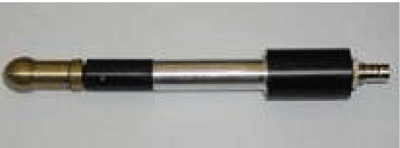
X rays are used for imaging the contents of vehicles and cargo. Because of the need to penetrate through the thickness of the wall of containers and vehicles in addition to the objects contained within, these systems rely on the use of penetrating radiation such as high energy megavoltage x rays with peak voltages of at least 5 MV. Currently, air-kerma measurements at these high energies are not directly traceable to national standards. Recommendations for the radiation protection of possible exposed occupants require in-beam measurements that would be better justified if properly traceable to national standards. A prototype small, brass-walled ionization chamber was designed and built at NIST to directly realize air kerma in such beams. Measurements are performed using megavoltage x-ray beams delivered by the Clinac accelerator at NIST. Correction factors, computed by Monte Carlo methods, will enable the measured ionization current produced in the brass wall chamber to be converted into air kerma. These correction factors are being determined for each beam in which the new chamber is placed for measurement. Further investigations are underway for realizing the quantity air kerma and providing traceable measurements to users of x-ray based security screening systems.