

Official websites use .gov
A .gov website belongs to an official government organization in the United States.

Secure .gov websites use HTTPS
A lock (
) or https:// means you’ve safely connected to the .gov website. Share sensitive information only on official, secure websites.


Summary
NIST and the University of Colorado have been funded since April, 2006, by DARPA to develop a microcryocooler with a volume less than about 4 cm3 to cool a terahertz detector to about 77 K. The approach uses a mixed refrigerant Joule-Thomson cooling process. The detector could be used for real-time passive detection of nonmetallic weapons at airport security lines. Other potential uses for such a cooler are for cooling infrared detectors. Sufficient thermal isolation was demonstrated during phase I to allow scaling to very small sizes and a temperature of 77 K was achieved during phase II in one experimental micro-cold head (heat exchanger and cold tip) using an optimized mixed refrigerant compressed with a commercial compressor.
Description
DARPA has been interested in the development of cooled detector systems (infrared and terahertz) that require less than 1 W of input power (battery operated) and have a total volume less than about 4 cm3. Such systems could be used for detection of enemy missile launches (infrared), chemical identification (infrared and terahertz spectroscopy), or smuggling of nonmetallic weapons (guns, knives, etc.) underneath clothing through airport security lines (terahertz imaging). Current state-of-the-art cryocoolers require at least several watts of input power and occupy tens of cubic centimeters of volume. They are designed for refrigeration powers of at least 150 mW. As detectors of various wavelengths of radiation improve, useful detection can be accomplished with only 3 to 10 mW of refrigeration power at temperatures in the range of 77 to 150 K. Input powers would be less than 1 W, which can be provided by small batteries. Microcryocoolers lead to useful detection systems that are hand-held.
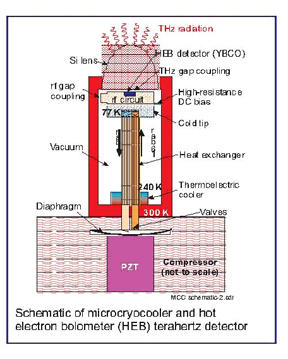
The objective of the project is to demonstrate that 3 mW of net refrigeration can be achieved at 77 K using less than 500 mW of input power. A schematic of the overall microcryocooler and the high temperature superconducting terahertz detector is shown in Figure 1. In scaling to very small sizes, scaling laws indicate thermal radiation and heat conduction can become serious problems. In order to show that proper scaling could be achieved, the major goal of the first 18 months (phase I) of the program was to demonstrate that sufficient thermal isolation at 77 K could be achieved. An experiment was devised using the same geometry of the heat exchanger and cold tip that showed we could achieve a thermal isolation at 77 K of greater than 40 000 K/W. The result showed that the cooler could be designed for a background heat leak from 300 K to 77 K of less than 6 mW. The use of an optimized mixed refrigerant with five components was calculated to provide sufficient refrigeration using the Joule-Thomson process with a pressure ratio of 16 to 1 and with a flow rate about ten times less than that using pure nitrogen gas. The low flow rate leads to a ten times smaller compressor and ten times less input power compared with a similar process using pure nitrogen. The lower flow also leads to a smaller heat exchanger and a significant reduction in radiation and conduction to the cold tip.
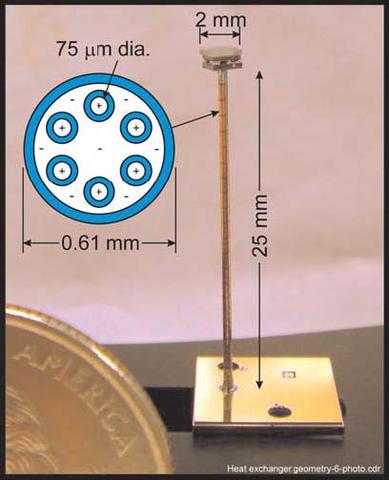
During phase II of the program, we have demonstrated that a temperature of 77 K could be achieved, but temperature oscillations occur below about 140 K, probably due to freezing of water vapor contaminants in the gas mixture in the 700 nm gap for the flow impedance in the cold tip. Figure 2 shows a photograph of the heat exchanger and cold tip. The heat exchanger consists of six 75 µm inside diameter glass capillaries enclosed by a larger glass capillary about 0.6 mm in diameter.
Major Accomplishments
- Calculate optimized mixed refrigerant for temperatures between 77 K and 240 K
- Demonstrate 43 000 K/W of thermal isolation at 77 K.
- Construct cold fingers using glass capillaries as heat exchangers
- Demonstrate cooling to 77 K and stable cooling to 140 K