Official websites use .gov
A .gov website belongs to an official government organization in the United States.

Secure .gov websites use HTTPS
A lock (
) or https:// means you’ve safely connected to the .gov website. Share sensitive information only on official, secure websites.


Wildland-Urban Interface Fire Group
The Wildland-Urban Interface (WUI) Fire Group develops, advances, and deploys measurement science to reduce risk of fire spread in communities.
Welcome
The Wildland-Urban Interface (WUI) Fire Group conducts research to reduce the risk of fire hazards in WUI communities. This research includes mission-related measurement science research and services to develop WUI fire risk exposure metrics, predict the spread of fires in WUI communities, assess the fire performance of structures and communities, and mitigate the effects of WUI fires on structures and communities through science-based codes and standards.
The WUI Fire Group accomplishes this work with the collaboration of various stakeholders, including:
- Federal agencies (e.g., FEMA, USFA, USFS)
- State agencies (e.g., CAL FIRE)
- Codes and standards organizations (e.g., NFPA, ICC, ISO)
- Fire research community (e.g., numerous academic institutions)
Highlights
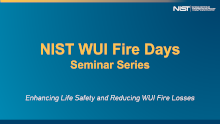
The NIST WUI Fire Group hosted virtual seminar series to present recent research findings in July 2022 and in November 2023. The events provided NIST the opportunity to share current research with a large, diverse audience dedicated to protecting people and structures from WUI fires.
NIST WUI Fire Days 2023 – Camp Fire notification/evacuation, ESCAPE, HMM, outdoor structure separation experiment (SSE) shed burns, fire spread from woodpiles
NIST WUI Fire Days 2022 – HMM, indoor SSE shed burns, IBHS shed burns, SSE modeling, fire spread along fences, firebrand/ember measurement.
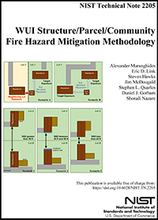
NIST, in collaboration with CAL FIRE and IBHS, has compiled a detailed list of mitigation actions to protect structures and parcels from ember and flame exposures in WUI fires. The methodology considers spatial relationships with parcel and neighboring parcel hazards to mitigate structure-to-structure fire spread in applicable scenarios. All structures must be protected from ember ignitions – the methodology presents 40 identified ember mitigation needs. See more at the project webpage.
The purpose of ESCAPE is to use the lessons learned from the NIST Camp Fire case study to present a methodology and other considerations about WUI fire incidents that can be used by small and intermediate-sized WUI communities to help develop notification and evacuation plans.
The ESCAPE project page is here and the ESCAPE report (NIST Technical Note 2262r1) can be found here.
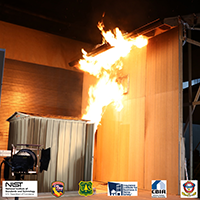
NIST WUI Fire Group is leading a multi-agency collaboration investigating the safe structure separation distance of structures in the WUI. In Phase 1, dozens of sheds are being burned to measure heat release rate, flame lengths, heat flux and thermal exposure to target walls. See more at the project webpage.
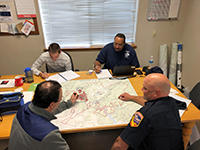
A case study of the 2018 Camp Fire in Butte County, CA is ongoing. The findings and lessons learned from the Camp Fire can be applied to mitigate the impact of WUI fires and help at-risk communities be better prepared for a potential fire. The research team has issued two major publications to date: 1) a fire progression timeline and fire behavior findings (NIST Technical Note 2135), and 2) a detailed account of notification, evacuation, traffic, temporary refuge areas, rescues, and fatalities (NIST Technical Note 2252). See more at the project webpage.
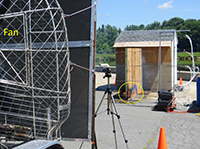
More than 200 experiments have been conducted with common detached combustibles found on residential parcels, including mulch, fencing, woodpiles, and landscape timbers. A comprehensive report is in progress. See more here.
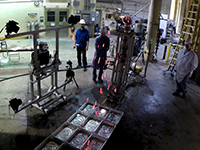
Development of the emberometer, a firebrand measurement device, is ongoing. Updates include system components and hardening for field/experimental usage, as well as analytical updates for ember sizing and uncertainty quantification. See more here.
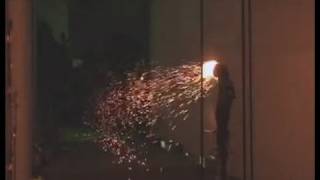
NIST's Firebrand Generator (also known as the "Dragon") produces showers of burning embers—or firebrands. Ingesting wood chips and exhaling firebrands, the novel equipment is used in research to better understand the behavior of wildfires that spread to communities.