

Official websites use .gov
A .gov website belongs to an official government organization in the United States.

Secure .gov websites use HTTPS
A lock (
) or https:// means you’ve safely connected to the .gov website. Share sensitive information only on official, secure websites.


Summary
This research will enable commercialization of a reduced flammability, inexpensive, and EHS[1] compliant polyurethane foam and a high smoldering reference foam to be used in standardized flammability tests. This will be accomplished by (a) evaluating a cost-effective and commercially viable nanoparticle coating technology to create a fire blocking armor on foam that reduces heat release and/or ignition propensity, (b) determining how to reduce foam flammability by controlling the foam characteristics and the manufacturing process, and (c) developing validated tools that enable EHS assessment of the nanoparticle-rich coatings for use in applications for the workplace and residence.
[1] Environmental, health, and safety (EHS). Only halogenated fire retardants are used in polyurethane foam. This class is under increased regulation due to potential EHS concerns. If banned, there are no commercially viable fire retardant alternatives for foam.
Description
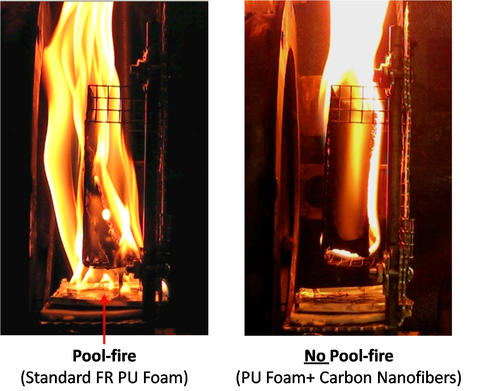
Objective: By 20152, to develop the measurement science that enables (1) design and manufacturing of low fire hazard soft furnishings through commercialization of low heat release, inexpensive, and EHS compliant nanoparticle-based fire retardant foam, (2) to assess the EHS attributes of nanoparticle fire retardants an innovative fire retardant technology for any polymer systems, and (3) develop a reference polyurethane foam with reproducible smoldering mass loss.
What is the new technical idea? This research will reduce the flammability of polyurethane foam to the extent that it becomes an alternative to comply with flammability regulations and will enable EHS assessments3 of this innovative fire retardant (FR) foam. There are two approaches being taken to reduce foam flammability. One approach is to evaluate nanoFR/LbL4,5, coatings as a technology to reduce the high, total, and rapid heat release of polyurethane foam. This includes characterizing the architectures of the nanoFR and the LbL coating and determining attributes of the LbL process (e.g., pH value, FR surface chemistry, foam air flow) that result in the greatest reduction in foam flammability and nanoFR release. Existing measurement tools lack the necessary spatial resolution; therefore, this project will also develop new measurement tools to characterize these architectures (e.g., FRET)6. The other approach is to identify the foam characteristics and the manufacturing process parameters7 that control foam flammability as this knowledge may enable manufacturers to reduce their dependence on FR. This knowledge will also be used to develop a high smoldering SRM foam that facilitates the evaluation of the nanoFR/LbL technology and may be used in state or national flammability regulations and tests8. The other part of this project is to develop the measurement science that enables others to determine if this nanoFR/LbL technology is an EHS compliant9 and, therefore, commercially viable. This project will provide agencies10 with the released materials and characterization of the released materials, which they will use to develop risk exposure models and define nanoparticle exposure threshold limits2.
What is the research plan? This project will be separated into three research tasks with the completion of each task being critical to meeting the overall project's objective.
Task 1 will evaluate and deploy nanoFR/ LbL fire retardant coatings as a cost-effective and commercially viable approach to reduce the fire hazard of foam. In year 1 (FY12), we identified and quantified factors of the coating process and recipe that impacted coating growth rate, morphology, and foam flammability. We then used this knowledge to develop a clay-based coating that reduced (in the Cone Calorimeter) the peak heat release rate (pHRR) of PUF by ~35% and the average HRR (aHRR) value by ~65%. Year 2 (FY13) was focused on further developing the technology and addressing concerns expressed by manufacturers that could prevent commercialization. We developed a coating that decreased the foam flammability more than in year 1 (reduction of 40% for pHRR and 80% for aHRR) using 50% less layers (e.g., 9 monolayers as compared to 20 monlayers). We demonstrated that the coatings are sufficiently durable that after 1 year of simulated stressing there is no loss in fire protection or mechanical integrity. We demonstrated (only in one test) that this technology does reduce flammability in a full scale fire test (50% reduction in pHRR and aHRR for a furniture mock-up). We measured an increase in foam stiffness from the coatings, but also measured that up to 90% of the flexibility is regained after compression three times (without loss in fire protection). In Year 3 (FY14), we will evaluate the commercial viability of this technology to approach to reduce the flammability of PUF in furniture. This will be accomplished by (1) evaluating novel chemistries (e.g., bio-based or naturally derived polymers) that enhance the effectiveness or reduce fabrication time (e.g., less layers and/or decreased HRR), (2) collaborating with the Residential Upholstered Furniture project (733-4010) to evaluate this technology in full scale furniture flammability experiments and, (3) working with manufacturers (e.g., FXI Foam) to understand the commercial pros and cons of using this technology (e.g., how to apply the coating in a full scale, what is an acceptable number of coating layers, and what are the aging durability requirements). The flammability performance of the LbL foam will be compared against other fire blocking technologies used in furniture (e.g., FR foam and barrier fabrics). The parameters measured during these full-scale experiments include pHRR, aHRR, time to ignition, time to extinction, and time to smoke obscuration. The furniture will be dissected post-test to understand the mechanism of fire resistance and what weakness of the fire blocking technologies resulted in its failure.
Task 2 will develop and deploy a reference foam (RF) and validated tools to measure foam flammability. The well-defined characteristics of a RF and the accuracy of the validated testing tools are essential for the evaluation of the nanoFR/LbL technology on foam (Task 1) and may be of value in standardized testing of foam containing products. In year 1 (FY12), we determined the factors critical to controlling foam smoldering performance (e.g., cell size, air flow, and porosity) and defined attributes that were critical to achieving sufficiently high smoldering11. Year 2 (FY13) was focused on improving the accuracy and reproducibility of the smoldering test so that it could be routinely used in regulations and standards (e.g., CPSC 1634). We found by using a reticulated PUF and modifying the testing equipment to enhance airflow that the uncertainty was reduced by a factor of 3 and the mass loss was increased by at least a factor of 2. Year 3 (FY13) is technology transfer for this task. We will work with the standards developing organizations and regulatory agencies to develop a smoldering test for covering fabrics based on the foam and testing device modifications we produced in year 2 of this task. Over the next 12 months, the California Bureau of Home Furnishings and Thermal Insulation (CBHFTI) will revise its smoldering furniture regulation (Cal 117)12. By conducting the smoldering tests in two configurations (i.e., current and NIST configuration) using three foams (i.e., current test foam and two NIST defined reference foams) and several CBHFTI defined covering fabrics, NIST will provide CBHFTI with the technical basis to define their testing protocols and regulation metrics, and the materials that will enable a reproducible and robust regulation. We will continue to assist CPSC as they define the direction for their furniture regulation. If CPSC's regulation is smolder-based, then the information we have provided to CBHFTI will also facilitate their regulation and we will transfer this technology to CPSC. If CPSC's regulation is open flame-based, the collaboration will primarily occur through the Residential Upholstered Furniture project.
Task 3 will develop and deploy validated tools to collect, quantify and characterize nanoFRs released during manufacturing, in-service, and pyrolysis of nanoFR foam. In year 1 (FY12), we developed and utilized a spectroscopic technique to quantify nanoFR release from foam as a function of stressing conditions and purchased a new tool (scanning particle mobility analyzer, SMPS) and designed and built an adjoining environmental chamber to quantify nanoFR release from char. Additionally we developed a collaboration with CPSC and Duke University13 to access the potential EHS impact of released nanoFR. Year 2 (FY13) we enabled Duke University to determine if there were any EHS concerns associated with the materials used in the LbL technology by providing them with data and materials collected from the stressing and the fabrication process. Preliminary results indicate no EHS issues. We are preparing a report and database on nanoparticles released from post-fire residues that will be shared with stakeholders, including regulatory agencies (e.g., Occupational Safety and Health Association). Year 3 (FY14) winds down work on measuring nanoparticle release. Over the last two years, we have provided the committees and Duke University, with materials and testing protocols to access the risk on nanoparticles in soft furnishings. These organizations are producing reports and holding meetings (which we are contributing to) that define what research is needed to enable nanoparticles to be used safely and effectively in consumer products. NIST activities in FY14 will be to complete our portion of these reports, continue to provide technical guidance, and, if necessary, participate in proposed round-robin testing of the release measurement methods.
[2] The project is it the last year of phase 1. The long term vision is to enable the development of a material independent fire retardant technology ("universal" fire retardant) that enables compliance with environment, health, and fire safety requirements.
- Phase 1: Reduced ignition and flame spread: Polyurethane foam
- Phase 2: Fire Resistant Systems: Upholstered Furniture
- Phase 3: Fire Resistant Systems: Home Electronics
[3] Global regulations restricting chemicals are based on toxicity measurements and the development of risk exposure models, which are outside the scope of this project as these are activities performed by regulating agencies or performed by other groups in accordance to the regulator's requirements.
[4] NanoFR/LbL is nanoparticle fire retardant coating creating using Layer-by-layer assembly. LbL assembly is a water-based process to fabricate coatings on a substrate that are constructed of several nanometer thick polymer layers of opposing charges, which may contain additives (e.g., FR). To date, this process is only commercially used for applying adhesives to tapes and in electronic circuit boards where the substrate geometry is essentially two dimensional and simple.
[5] Development of innovative technologies to develop cost-effective fire-safe materials is listed as a critical cross cutting strategic focus area that has the potential to simultaneously impact several aspects of the national fire problem (Draft Measurement Science Roadmap for Innovative Fire Protection). LbL assembly and nanotechnologies are listed as innovative technologies that need to be developed, and soft furnishing and foam are listed as products needing innovative fire safe approaches.
[6] Förster resonance energy transfer (FRET) combined with laser scanning confocal microscopy (LSCM) to measure the amount and quality of the interface between nanoFR and polymer, LbL layers and substrate, etc. This is a new technique being developed jointly between Fire Research and Polymer divisions. There are significant measurement science issues to address (e.g., appropriate dye tags, and detector and laser resolution).
[7] Foam manufacturers alter their process and formulations to meet selling specifications (e.g., color and firmness). These changes will alter other foam characteristics (e.g., air flow and surface energy), which have unknown and perhaps inconsistent impact on the foam flammability and the effectiveness of FR technologies.
[8] Consumer Product Safety Commission (CPSC) 16 CFR 1634 is a proposed regulation for limiting the flammability of upholstered furniture. The regulation is based on using a chair mock-up (not a fully built commercial chair) and is primarily focused on restricting/approving cover fabrics that result in failing/meeting the specified flammability metrics. This SRM could be used CPSC 16 CFR 1634.
[9] Strategy for Nanotechnology-Related Environmental, Health and Safety Research report by National Science and Technology Council Committee indicates a critical gap in accessing the toxicity of the released materials and developing risk models of exposure is accurate and highly sensitive nanoparticle measurement tools and collection of actual release materials (both of which are addressed in this proposal).
[10] CPSC and OSHA are considering regulating the release of nanoparticles during manufacturing and in-service, respectively, from consumer products, but lack the measurement science needed to determine if it is necessary.
[11] Reproducible smoldering foam enables the development of regulations that qualifies covering fabrics to be used in upholstered furniture. A highly smoldering (high mass loss) foam requires the covering fabrics to be more smolder resistant or fire blocking technologies to be used to comply with the regulations (once they are defined over the next 12 to 16 months). This foam enables the regulators to define and when necessary change the furniture flammability metrics without being concerned about identifying another foam. In other words, the regulations can be adjusted to allow more or less covering fabrics into the furniture market by simply adjusting the time of the test rather than trying to find another foam that is more or less smolder resistant.
[12] Cal 117 is currently defined as an open flame regulation. CBHFTI has announced this will become a smoldering regulation and has defined the outline for the testing procedure.
[13] Duke University is the leader for the EPA and NSF funded Center for the Environmental Implications of Nanotechnology (http://www.ceint.duke.edu/) and is tasked with developing the risk assessment models for the use of nanoparticles.
Major Accomplishments
Research Outcomes:
- Kim, Y. S., et al., (2012). "First Multiwalled Carbon Nanotube Layer-by-Layer Coating that Significantly Reduces Polyurethane Foam Flammability." Submitted to Thin Solid Films.
- Davis, R. D., et al. (2013). "Controlling Foam Flammability and Mechanical Behavior by Tailoring the Composition of Clay-Based Multilayer Nanocoatings." Submitted to Polymer Degradation and Stability.
Potential Research Impact:
- Kim, Y. S., et al. (2012). "Innovative Approach to Rapid Growth of Highly Clay-Filled Coatings Foam." ACS Macro Letters 1: 820-824.
Realized Research Impact:
- New fire retardant approaches developed based on the understanding of Layer-by-Layer assembly and foam flammability. (1) Kim, Y. S., et al. (2011). "Development of layer-by-layer assembled carbon nanofiber-filled coatings to reduce polyurethane foam flammability." Polymer 52(13): 2847-2855. (2) Kramer, R. H., et al. (2010). "Heat release and structural collapse of flexible polyurethane foam." Polymer Degradation and Stability 95(6): 1115-1122.
Impact of Standards and Tools:
- Draft modification of California 117 (Residential upholstered furniture) regulation to use NIST recommended reference smoldering foam and modification of the test device.14, 15
Other:
- Joint American University and NIST patent application for fire resistant coatings on residential furniture foam.16
- Development of a reference polyurethane foam (SRM1202) and standardized testing guidelines17 for accessing the smolder resistance of fabrics used in furniture. The SRM is being considered for state and federal regulation flammability testing.
[14] (1) Zammarano M, Matko S, and Davis R.D. (2013) "Impact of Test and Foam Design on Smoldering," NIST Technical Note 1799, National Institute of Standards and Technology, Gaithersburg MD, April 2013. (2) Zammarano, M., S. Matko, et al. (2013). Chapter 26: Smoldering in Flexible Polyurethane Foams: the Effect of Foam Morphology. Fire and Polymers VI: New Advances in Flame Retardant Chemistry and Science, ACS.
[15] Project Standards and Codes involvement: (1) ASTM E5.15: Contents and Furnishings. Gann is Task Group Chair and has shared information showing that foam flammability can be reduced using the nanoFR coatings. (2) CPSC 16 CFR 1634: Upholstery Furniture Regulation. Davis provides technical guidance on the testing methodology and materials, and through this project leads the development of this technical basis. The SRM 1202 may potentially be used in this regulation. (3) CBHFTI: Upholstery Furniture Regulation. Davis provides technical guidance on the testing methodology and materials, and through this project leads the development of this technical basis. The SRM 1202 may potentially be used in this regulation. (4) CPSC: Nanoparticle Regulations in Consumer Products: Davis provides technical materials and technical guidance to CPSC and collaborators that are conducting risk assessments of nanoparticles used in soft furnishings. Davis will contribute to the technical component of a regulation restricting use of nanoparticles in these consumer products if CPSC decides to proceed based on the finding of risk assessments. Decision point for moving toward regulating is expected within the next 18 to 24 months. (5) EPA's Decabromo and Hexabromo Fire Retardant Replacement Committees: Davis is a voting member of the steering committees that are evaluating EHS compliant and commercially viable alternatives for these "restricted or banned use" fire retardants and is coauthoring EPA regulatory guidance documents for these fire retardants. (6) National Nanoparticle Initiative: Davis is a member of this multiagency committee and several of it subcommittees that are developing standardized approaches for accessing nanoparticle EHS and a roadmap for all nanoparticle research conducted by Federal agencies. The results of these committees will be the formation of national regulations on the handling, storage, and use of nanoparticles. (7) Polyurethane Foam Association: Manufacturer's trade group. Davis working with PFA to identify candidates for evaluating LbL.
[16] Intellectual Property Disclosure 2013-01-DMF was submitted on January 23, 2013. June, 15, 2013 American University start the process for filing patent application. Application umber has not been assigned yet.
[17] Davis, R. D., M. Zammarano, et al. (2012). "NIST TN 1775: Standard Operating Procedures for Smoldering Ignition Testing of Upholstery Fabrics." NIST TN: 24.