

Official websites use .gov
A .gov website belongs to an official government organization in the United States.

Secure .gov websites use HTTPS
A lock (
) or https:// means you’ve safely connected to the .gov website. Share sensitive information only on official, secure websites.


Summary
The refrigeration and air-conditioning industry is moving to limit or phase out several refrigerants currently used in commercial and residential cooling and heating equipment because of global agreements to limit the release of substances contributing to global warming and ozone depletion. The environmental criteria for the future refrigerants include zero ozone depletion potential (ODP), low global warming potential (GWP), and high efficiency. This project will benchmark the heat transfer properties of the leading replacement candidates and will measure and model their overall thermal performance in a vapor compression system.
Description
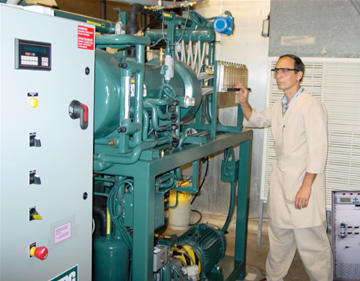
Objective - To develop heat transfer and system performance information that will assist in the selection and implementation of the best replacements for high-GWP hydrofluorocarbon (HFC).
What is the new technical idea?
Most of the currently used HFC refrigerants will be phased out or phased down because of their relatively large global warming potential. Consequently, candidate replacement fluids must be researched and evaluated. The scope of the evaluation includes two-phase heat transfer and cycle measurements that will support the development of a prediction model for a comprehensive and fair comparison of low-GWP refrigerants. For complete characterization of new fluids, fundamental heat transfer and pressure drop measurements will be taken in a two-phase heat transfer apparatus, and cycle performance will be measured in a laboratory heat pump apparatus. The prediction model will be a new cycle simulation-based tool that will determine refrigerant performance parameters, volumetric capacity, and coefficient of performance while accounting for the refrigerant’s thermodynamic and transfer properties. The new tool will provide more realistic predictions of low-GWP refrigerant performance than conventional theoretical models based on refrigerant thermodynamic properties alone.
What is the research plan?
The research plan encompasses three Products. Within Product 1, the two-phase heat transfer of candidate replacements for high-GWP refrigerants will be determined. In previous project years, two apparatuses were used to measure local convective-boiling and pool-boiling of several low-GWP candidate refrigerants inside a micro-fin tube and on an enhanced surface, respectively. The test fluids were selected based on information from U.S. refrigerant manufacturers and by theoretically evaluating the performance of 40 potential low-GWP refrigerants as identified by the Air-Conditioning, Heating, and Refrigeration Institute’s (AHRI) Low-GWP Alternative Refrigerants Evaluation Program (AREP). Three more low-GWP refrigerants will be tested during FY2021. For each refrigerant, roughly eighty discrete operating points will be recorded to characterize the heat flux and governing temperature difference for the database. The heat transfer measurements for low-GWP refrigerants will broaden the fluid database in the literature, which will be used to extend the validity of an existing NIST heat transfer correlation to low-GWP fluids. Because some of these test refrigerants may be mildly flammable having an ASHRAE 2L designation, modifications have been made to the test rigs to safely test the 2L refrigerants.
Product 2 consists of the laboratory characterization of low-GWP refrigerants in a mini-breadboard heat pump (MB-HP). This laboratory apparatus is equipped with specialized, variable-area heat exchangers, a variable-speed compressor, and two water chillers to control the temperatures of the heat source and the heat sink. Six low-GWP refrigerants and baseline refrigerants have been tested and compared to the CYCLE_D-HX model developed within this project. Further CYCLE_D-HX validation is planned in FY2021. The end goal is for the MB-HP apparatus and CYCLE_D-HX model to be a set of complementary tools for evaluating performance merits of new generation of refrigerants.
The modeling element of this project (Product 3) supports two NIST Standard Reference Databases (SRDs): CYCLE_D, for evaluating refrigerant cycle performance based on thermodynamic properties (https://www.nist.gov/srd/nist-standard-reference-database-49), and REFLEAK, for estimating the composition shift of zeotropic refrigerant blends resulting from the leak/recharge processes (https://www.nist.gov/srd/nist-standard-reference-database-73). Also, developmental work took place on a new cycle model, CYCLE_D-HX, which accounts for both thermodynamic and transport properties of refrigerants. The inclusion of transport phenomena within the heat exchangers enables the analysis and optimization of the fundamental trade-off between the pressure drop penalty and refrigerant heat transfer enhancement with increasing refrigerant mass flux. CYCLE_D-HX has been completed, validated with extensive testing, and placed on the EL website in FY2018 for free download (https://www.nist.gov/services-resources/software/cycled-hx-nist-vapor-c…). These three programs are under continuous maintenance and are upgraded, as needed, to assist the industry in the transition to new-generation refrigerants.
Major Accomplishments
Realized Impact:
- Standard Reference Database 49, CYCLE_D, (http://www.nist.gov/srd/nist49.cfm) is used by manufacturers, consultants, and academics to evaluate different refrigerant options including new HFO refrigerants and the CO2 transcritical cycle.
- Standard Reference Database 73, REFLEAK, (http://www.nist.gov/srd/nist73.cfm) is used by industry to prepare their submittals to ASHRAE Standard Project Committee 34. It is also used by this ASHRAE SPC 34 to evaluate received submittals.