

Official websites use .gov
A .gov website belongs to an official government organization in the United States.

Secure .gov websites use HTTPS
A lock (
) or https:// means you’ve safely connected to the .gov website. Share sensitive information only on official, secure websites.


Summary
NIST is developing the measurement science required to support strategies that maintain or improve indoor air quality (IAQ) in buildings. Changes that are being made in the design, operation and furnishing of buildings to save energy and promote resilience have the potential to alter the indoor environment and could adversely affect the health and productivity of building occupants. This project seeks to provide the measurement science to support the development of industry-consensus standards and guides to 1) ensure a level playing field for portable air cleaner manufactures by quantifying how portable air cleaners impact indoor air chemistry; 2) reduce the financial burden of wildland urban interface fires by providing science based best remediation practices for buildings that survive in a fire region; and 3) provide technical guidance on the optimal use of advanced analytical equipment for indoor air quality standards. Together these efforts will provide improved standards and guides to optimize buildings and operate products relevant to the indoor environment in an efficient and safe manner.
Description
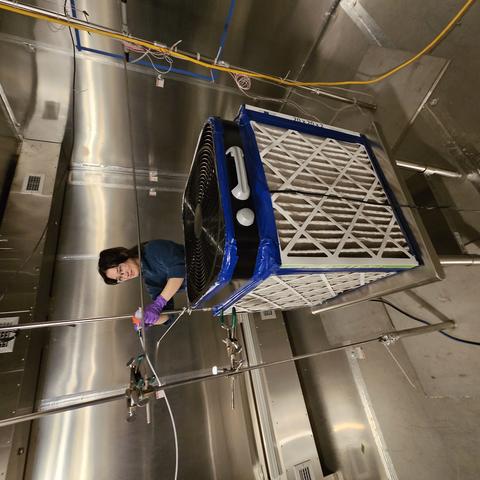
Using NIST's large chamber test facility, researchers are assessing how portable air cleaners impact indoor air chemistry.
Objective
To provide the measurement science to lead the development of industry-consensus standards and guides to optimize buildings and operate products relevant to the indoor environment and indoor air quality in an efficient and safe manner.
Technical Idea
This project seeks to provide the measurement science to lead and support the development of consensus test methods, guides and IAQ related control strategies that make buildings safer and more efficient for productive uses.
Ozone emission from air cleaners.
Air cleaning devices have increased in popularity over the last few years due to concerns about wildfire smoke and indoor airborne infectious aerosols. A wide variety of technologies have entered the marketplace. Some of these electronic air cleaning devices have the potential to create ozone which can have negative indoor air quality impacts. Current test standards for ozone emission from air cleaners do not properly account for newer technologies (e.g. GUV lamps). This effort will produce the data required to update existing standards to accommodate pathogen control technologies (e.g., GUV lamps).
Wildland Urban Interface (WUI).
With the proliferation of wildfires impacting the indoor environment, appropriate methods to reduce the long-term impact of fire related chemicals indoors is lacking. The effectiveness of wiping, vacuuming, rug cleaning, and other methods at reducing the reservoir of WUI-delivered chemicals needs to be determined. Once determined, WUI recovery guidelines and recommendations for the general public can be optimized and updated.
Indoor Air Analytical Challenges.
The use of advanced analytical equipment is rapidly expanding in the indoor air field, including the use of such equipment in standards. This equipment includes Proton-Transfer-Reaction Mass Spectrometry (PTR-MS). PRT-MS allows part per trillion detection of airborne chemicals at second time resolution. Historically used for the lower concentration of outdoor air, NIST has identified complications when using the equipment in the indoor environment. Specifically, the combination of PTR-MS combined with gas chromatography has shown that signals once attributed to a single chemical may include contributions from multiple chemicals and chemical fragments. The impact of this complication can be PRT-MS misapplication in standards used to quantify chemicals indoors. This effort will create a standardize guide for the operation of PTR- MS use in indoor air quality standards and regulations.
Research Plan
Ozone emission from air cleaners.
NIST is leading an international effort to overhaul UL 8676. The standard will be revised to move from an arbitrary ozone concentration limit to a more useful ozone emission rate (mass/time). NIST will lead the UL 867 revision effort and perform tests to create a crosswalk between the existing concentration approach and the new emission rate approach. This will allow existing regulations and standards (ASHRAE 241, 62.1, 62.2)7 to point a more scientifically rigorous testing standard.
Wildland Urban Interface (WUI).
The NIST manufactured house will be exposed again to a series of smoke events using controlled burns. Chemicals related to the burns will coat the interior of the house. The effectiveness of a variety of cleaning activities will be assessed over a period of months using a PTR-Tof-MS.
Indoor Air Analytical Challenges.
NIST will lead a team of over 20 stakeholders to draft an ASTM guide for the best practices and optimization for the use of PTR-Tof-MS in indoor environments and testing standards.
Major Accomplishments
Impact of Standards and Tools:
- NASEM report serves as a roadmap for funding agencies and academic researchers for future indoor air quality research.
- Germicidal ultraviolet lamp ozone production efforts have led to collaborative efforts with industry associations to optimize lamp use for airborne pathogen inactivation.