

Official websites use .gov
A .gov website belongs to an official government organization in the United States.

Secure .gov websites use HTTPS
A lock (
) or https:// means you’ve safely connected to the .gov website. Share sensitive information only on official, secure websites.


Manipulating the Position and Orientation of Nanoparticles using Feedback Control (Archived)
Summary
To advance the development of miniaturized systems, there is a need to place nanostructured materials in very precise locations. Only then can practical applications move forward, such as bonding particles to sensors, connecting nanowires to electrical leads, fabricating waveguides, probing biological cells, building chemical sensors for sensing trace levels of toxins, or combining nanoscale building blocks to build up functioning micro- and nano- scale systems. To address the needs of reliably completing this difficult task on a mass-producible scale, we are developing new methods to more accurately locate and then place atomic and nanoscale objects. The goal of this project is to create high resolution, feedback control-based methods to move particles with greater precision via electrical fields, fluid dynamics, or other means.
Description
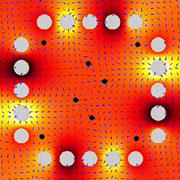
Particles suspended in liquid can be manipulated through the phenomenon of electro-osmotic flow, which is created when a voltage is applied across a liquid in a microfluidic device. The application of multiple voltages at strategic locations around such a device enables a particle to be steered in any arbitrary direction. If information about the particle's location, obtained through video microscopy, is combined with a physical model of the way the applied voltage affects the fluid flow, then a feedback control system can be built. A properly designed system can enable the motion of several particles to be controlled independently and simultaneously. The project team is combining the microscale control expertise developed at the University of Maryland with the capabilities for precise and accurate nanoscale particle position sensing created at CNST in order to allow them to precisely control particle motion at the nanoscale.
A second aspect of the project is controlling not only the position, but also the orientation of objects whose functionality depends on their orientation, such as nanorods. Previous approaches for controlling the nanorod orientation relied on the particle having specific properties, such as electric charge, dipole moment or magnetic moment, and required the fabrication of intricate devices. Using an approach which offers significant advantages compared to other techniques, the research team is developing a device that creates a controllable amount of shear flow on the nanorod. The method also allows for manipulation of a wider class of particles because the particle does not have to be charged or have a dipole or magnetic moment. The particle can be controlled over hundreds of micrometers with sub-micrometer accuracy. The device is very easy and inexpensive to make, requiring only the molding of an inexpensive elastomer. The goal of this project is to couple our device with a robust feedback control law and vision algorithm so that it can ultimately be used to translate and rotate multiple sub-micron rigid particles of arbitrary shape. Ultimately, such particles will be used as sensors to provide position and orientation dependent signals from their local fluid environment.
The third and final aspect of the project deals with the challenge of controlling groups of particles that are so numerous that controlling the individual particles is no longer possible. In this case we combine the in-depth knowledge of particle interactions developed at Johns Hopkins with the CNST's expertise in feedback control to ensure that the particles assemble into the desired configurations despite the statistical nature of their individual behavior. We use multiple types of particle actuation mechanisms such as electro-osmotic flow and dielectrophoresis together with video feedback to control the formation of particle assemblies. This is the first step in using external fields, in conjunction with carefully engineered particle-particle interactions, to develop approaches that will eventually be applied in full-scale nanomanufacturing.
Selected Publications:
Multiple electrokinetic actuators for feedback control of colloidal crystal size, J. J. Juárez, P. P. Mathai, J. A. Liddle, and M. A. Bevan, Lab on a Chip 12, 4063–4070 (2012).
NIST Publication Database Journal Web Site
Simultaneous positioning and orientation of a single nano-object by flow control: theory and simulations, P. P. Mathai, A. J. Berglund, J. Alexander Liddle, and B. A. Shapiro, New Journal of Physics 13, 013027 (2011).
NIST Publication Database Journal Web Site