

Official websites use .gov
A .gov website belongs to an official government organization in the United States.

Secure .gov websites use HTTPS
A lock (
) or https:// means you’ve safely connected to the .gov website. Share sensitive information only on official, secure websites.



Physics


From the second to the kilogram, NIST develops and distributes definitive U.S. standards for almost every kind of physical measurement to support commerce, scientific discovery and technology. NIST’s work on the science of physical measurement addresses areas of critical national importance, including manufacturing, communications, health care, semiconductor electronics, law enforcement, space exploration, homeland security and military defense. NIST provides the technical expertise that U.S. industry, government and academia need for continued world leadership in science and technology.
NIST’s activities include helping to modernize the metric system, known as the International System of Units (SI), for 21st century science and technology; pushing the frontiers of measurement for quantum research; operating a world-class neutron facility for science and industry; fabricating and measuring devices at the nanometer scale; and developing new capabilities for physical science applications from ensuring the safety of medical radiation procedures to strengthening supply-chain security.
Key Accomplishments
- Kibble balances: NIST helped to redefine the kilogram, the international unit of mass, through the use of a large electromechanical device known as a Kibble balance. NIST researchers have created smaller, portable versions of Kibble balances, and recently delivered one to the U.S. Army so that it can perform precision mass measurements onsite.
- Atomic clocks: NIST built the world’s first atomic clock in 1948 and remains a global leader in developing the technology. NIST provides the U.S. civilian time standard, and its next generation of atomic clocks could help enable even more precise timekeeping. Learn more about atomic clocks, how they work, and what they're used for (from GPS navigation to oil exploration).
- Frequency combs: NIST scientists first developed these “rulers of light” to improve atomic clocks. Frequency combs are now used in a wide range of applications, from detecting disease in human breath and locating gas leaks to searching for planets outside the solar system.
- NIST on a CHIP: NIST is bringing cutting-edge measurement science technology from our labs directly to users in commerce, medicine, defense and academia. In collaboration with industry and other government agencies, we are developing a suite of inherently accurate measurement technologies that operate according to the precise, time-tested principles of quantum physics. Learn more about NIST on a CHIP.
Explainers

Quantum Computing Explained

Optical Frequency Combs
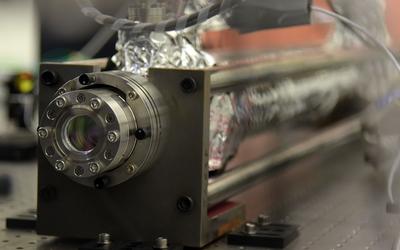
Spectroscopy: A Measurement Powerhouse
News and Updates

New Chip-Based ‘Tape Measure’ for Light Could Revolutionize Mobile Timekeeping and Enhance National Security

NIST Study Shows How the Toxic Substances Mixed Into Fentanyl Vary Across the U.S. and Change Over Time

Physicist Jun Ye Wins Wolf Prize in Physics
Featured videos
Can an Electron Explain the Origin of the Universe?
Einstein, Time, and Very Small Things - with Jun Ye
Why Do We Use Atoms To Keep Time?
Blog Posts
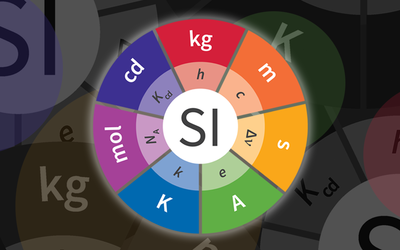
How Many Units Should Be in the Metric System? Even NIST Experts Disagree.

The International System of Units: A Never-Ending Quest for the Perfect Measurement System
