Summary:This program addresses the gap between basic research and building codes, standards, and practice through measurement science research to: (1) predict structural performance to failure under extreme loading conditions: (2) predict disaster resilience at the building and community scale; (3) assess and evaluate the ability of existing structures to withstand extreme loads; (4) design new buildings and retrofit existing buildings using cost-effective, performance-based methods; and (5) derive lessons learned from disasters and failures involving structures. Description:Objective: To develop and deploy advances in measurement science to enhance the resilience of buildings and infrastructure to natural and manmade hazards by 2016. What is the problem? Natural and manmade disasters cause an estimated $57 billion in average annual costs (and growing), with catastrophes like Hurricane Katrina and future “Kobe” earthquakes causing mega-losses exceeding $100B. Existing extreme load-related prescriptive requirements of building codes, standards, and practices stifle design and construction innovation and increase construction costs. The risk in large disaster-prone regions of the Nation is substantially greater now than ever before due to the combined effects of development and population growth. As noted by the National Science and Technology Council, “…a primary focus on response and recovery is an impractical and inefficient strategy for dealing with [natural disasters]. Instead, communities must break the cycle of destruction and recovery by enhancing disaster resilience.”[1] The link between basic research and building codes, standards, and practices is weak. Further, the measurement science is lacking to: (1) predict structural performance to failure under extreme loading conditions: (2) predict disaster resilience at the building and community scale; (3) assess and evaluate the ability of existing structures to withstand extreme loads; (4) design new buildings and retrofit existing buildings using cost-effective, performance-based methods; and (5) derive lessons learned from disasters and failures involving structures. Why is it hard to solve? The natural processes that produce risks in the built environment and the information relative to those risks for use by design professionals, standards developers, and emergency planners are not well understood. Cost-effective mitigation strategies that improve the performance of structural systems are complex, often lying outside the breadth of the prescriptive procedures that dominate building codes, standards, and practices. Methods for transferring basic research results into practice are limited. The engineering community lacks standard methods of predicting, evaluating, and assessing the disaster resilience of structures as they respond to extreme loads. Communities lack standard methods of assessing disaster resilience at the community scale for use in making disaster preparedness and mitigation decisions. How is it solved today, and by whom? The problem is not solved today although progress is being made. The disaster resistance of structures and disaster resilience of communities is determined by building codes, standards, and practices used when structures were built – most older structures have only minimal resistance. Most codes, standards, and practices are highly prescriptive, simplified, and inconsistent with respect to risk – stifling innovation and increasing cost. There is a lack of validated tools and metrics to evaluate structural and community performance, as well as the risks to which they are exposed – the lack of accurate models increases conservatism and decreases cost-effectiveness. Codes and standards are developed by private sector organizations that often lack the resources needed to develop the technical bases to improve them – practices, codes, standards used in design, construction, and retrofit are based largely on research performed or supported by the government. Why NIST? This program supports the EL mission of promoting U.S. innovation and competitiveness by anticipating and meeting the measurement science, standards, and technology needs of the U.S. building and fire safety industries in ways that enhance economic security and improve the quality of life. The program supports the EL core competency in resilience and reliability of structures under multi-hazards. The program further fulfills a national knowledge transfer role that is not well-supported by a fragmented U.S. construction industry (ACI 318, AISC, ASCE 7). Finally, NIST has statutory responsibilities including: (1) the National Windstorm Hazards Reduction Act (2004); (2) the Fire Prevention and Control Act (1974); and (3) the National Construction Safety Team Act (2002). What is the new technical idea? The fundamental new idea is that disaster resilience can be enhanced significantly by developing a robust capability to predict the effects of hazards on the performance of complex structural systems and on community-wide response. This will be achieved by developing: (1) validated data to characterize the hazard environment; (2) validated physics-based models to predict performance of structures to failure; (3) metrics for measuring performance; (4) acceptance criteria for differing levels of performance objectives; (5) mitigation strategies based on evaluated performance; and (6) science-based tools to estimate losses and predict resilience at the community scale. The scope of the research includes extreme wind engineering and structural fire resistance with progressive collapse and multi-hazard failure analysis being cross-cutting research topics. Development of cost-effectiveness tools for evaluating multi-hazard risks at the community scale and implementation of the World Trade Center recommendations for research and development are also a part of this program. Why can we succeed now? It is possible to succeed now because there is strong demand from the general public and policy makers for enhancing disaster resilience of communities and reducing losses from future disasters as well as demand from the private sector to fill science and technology gaps. Recent advances in the relevant technical disciplines and in computational capabilities make possible significant advances in the component research topics. Finally, there is an increasing body of fundamental structural behavior knowledge available from NSF-supported basic research. What is the research plan? The program consists of five research thrusts: (1) Develop validated tools that predict structural performance to failure under extreme loading conditions. This research thrust consists of three elements:
(2) Develop community-scale loss estimation tools to predict consequences of disasters, leading in turn to increased resilience. This research thrust consists of two elements:
(3) Develop validated tools to assess and evaluate the capabilities of existing structures to withstand extreme loads. This research thrust consists of three elements:
(4) Develop performance-based guidelines for cost-effective design of new buildings and, where warranted, rehabilitation of existing buildings. This research thrust consists of four elements:
(5) Derive lessons learned from disasters and failures involving structures. This research thrust consists of three elements:
How will teamwork be ensured? Within each of the component projects, the individual team members have been assigned based upon their specific expertise and have well-defined, complementary roles within their projects. This program is highly synergistic with EL’s National Earthquake Hazard Reduction Program (NEHRP) and there will be close collaboration between the two programs. Established collaborations with the Fire Research Division, the Office of Applied Economics, the Statistical Research Division, and Mathematical and Computational Sciences Division (ITL) will bring important capabilities to bear on the component research projects. Partnerships with other Federal agencies complement the capabilities of the NIST team (e.g., large-scale experiments). What is the impact if successful? The impact of this program will be significantly enhanced disaster resilience (with respect to extreme loads) of the nation’s communities and built environment. This will result in reduced societal risk and reduced cost and operational impacts of disasters on individuals, businesses, and government. The program will also foster a transformation from prescriptive to performance-based design codes and standards. This transformation will enable innovation in materials, technologies, and system designs and foster cost-effectiveness, thus enhancing the U.S. construction industry’s international competitiveness. A number of key stakeholder groups will have an interest in the outcomes of this program. At-risk communities and the American public are a key stakeholder and beneficiary of this program. Government at all levels that is responsible for pre-disaster mitigation and for response, recovery, and rebuilding in the aftermath of catastrophic disasters will also have a keen interest in the products of this research program. Design and construction practitioners, facility owners and operators, standards and codes developers, state and local building officials, and property risk insurers will all benefit from the results of this research. Impacts already achieved by the program include the 40 model building and fire code changes consistent with the NIST WTC investigation recommendations now required by the International Code Council’s (ICC) I-Codes. Similarly, the National Fire Protection Association (NFPA) has adopted 15 changes responsive to the World Trade Center Recommendations for inclusion in the 2009 Editions of the NFPA 5000 Building Code, NFPA 1 Fire Code, and NFPA 101 Life Safety Code. Specific EL Products Near-Term (by 2012):
Medium-Term (3-8 years):
Long-Term (beyond 8 years):
What is the standards strategy? The component projects that make up the Structural Performance Under Multi-Hazards program have been structured to produce specific major products that can be transferred directly to standards development organizations. Project team members have established themselves in key standards committee positions within ASCE/SEI 7, AISC, ACI, and ISO that are directly relevant to the current research areas and consistent with the EL mission. Furthermore, the program has recently submitted an application to participate as a member of the IBC-Structural committee, which will strengthen the ability of the program to work directly with the code bodies to affect improvements to the code where appropriate and relevant to the results of our research and consistent with the EL mission and the desire of ICC to work more closely with NIST. Within the structural engineering community, ASCE/SEI 7 is the standard for minimum design loads for buildings and other structures. It is referenced by the International Building Code and in turn references ACI 318 and AISC Design Specifications for Structural Steel. Focusing on these standards ensures that the provisions based on NIST research will have broad application in the industry. Top standards development needs for the program include the following:
The above standards are generally updated on 5-year basis. For example, the next opportunity to introduce new or updated standards into ASCE/SEI 7 is in the 2016 edition. The major research products that lead to new or significantly improved code provisions are introduced during these major code cycles. In some cases, opportunities may be available on a different cycle to implement supporting provisions in standards documents that are referenced by the above standards. How will knowledge transfer be achieved? Knowledge transfer will be accomplished through several mechanisms. Research results will be disseminated to key standards, codes, and industry organizations including: American Society of Civil Engineers/Structural Engineering Institute, American Institute of Steel Construction/American Iron and Steel Institute, American Concrete Institute, ASTM International, International Standards Organization, International Code Council, and the National Fire Protection Association, through active participation by NIST staff and submittal of pre-standards for consideration by the appropriate organizations. NIST also collaborates with industry and academia through grants and other mechanisms to conduct complementary research. The NIST guest researcher program and other vehicles allow collaboration with experts through joint research efforts. NIST provides guidance to industry on best practices, design, and rehabilitation techniques to withstand extreme loads, and assessing disaster resilience at the community scale. Finally, NIST publishes research results in peer-reviewed journals and conference proceedings. Major Accomplishments: Prevention of Disproportionate Structural Collapse
Fire Resistance Design and Retrofit of Structures
Wind Engineering and Multi-Hazard Failure Analysis
Fire Resistive Materials for Structural Steel
Standard Methods to Assess the Resilience of the Built Environment
Recognition of EL: Department of Commerce Special Act Award presented to staff members involved in the investigation of the World Trade Center 7 Collapse Investigation. Department of Commerce Silver Medal awarded to Stephen Cauffman, Long Phan, Fahim Sadek, and Dat Duthinh for conducting the reconnaissance of the performance of physical structures following Hurricane Katrina and Rita (2007). Department of Commerce Bronze Medal awarded to Long Phan and Emil Simiu for work leading to the development of the Enhanced Fujita Tornado Intensity Scale (2006). Department of Commerce Gold Medal awarded to the World Trade Center Investigation Team (2005). Invited lectures at international institutions. |
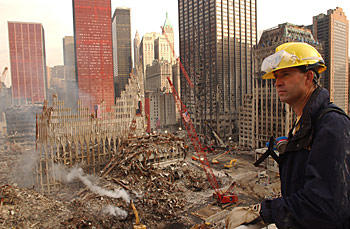
![]() Worker looks over the disaster site at New York City’s World Trade Center complex a few days after the Sept. 11, 2001, terrorist attacks. Photo credit: FEMA Start Date:October 1, 2011Lead Organizational Unit:elRelated Programs and Projects:Contact
|