

Official websites use .gov
A .gov website belongs to an official government organization in the United States.

Secure .gov websites use HTTPS
A lock (
) or https:// means you’ve safely connected to the .gov website. Share sensitive information only on official, secure websites.


Support of Industry Compliance with the EU Directive on Restriction of Certain Hazardous Substances (RoHS)
Summary
The Chemical Sciences Division is involved in development of standards and reference materials for restricted hazardous substances through participation in international test method development programs, by providing existing Standard Reference Materials (SRMs) for test method validation, and by investing in development of new SRMs.
Chemical Sciences Division involvement with RoHS is based in large measure on feedback obtained during a NIST workshop in October 2005, which resulted in a prioritized list of materials for new SRMs. Current projects include production of SRMs for lead-free solder and free-cutting brass containing high levels of restricted substances. Collaborations are underway with the National Institute of Metrology of China (NIM-C) and the Institute for Reference Materials and Measurements (IRMM) of the European Union (EU).
Description
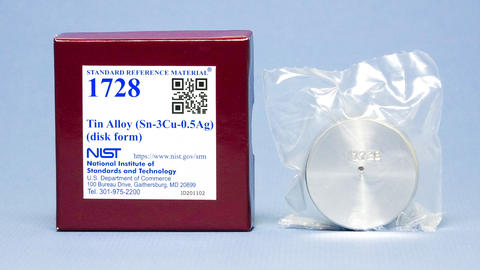
SRM 1728 Tin Alloy (SN-3CU-0.5Ag) (disk form). This SRM is intended for use in the evaluation of chemical and instrumental methods of analysis and in calibration of analyses for bulk elemental composition in tin solder alloys.
This project is intended to create tools for metrologically sound sampling, analysis, and testing of consumer products, their raw materials, and intermediates for the purpose of compliance with worldwide regulations governing contents of hazardous and declarable substances including hexavalent chromium, cadmium, mercury, lead, polybrominated biphenyls (PBB), and polybrominated diphenylether (PBDE) compounds in electronic and electrical products. Activities are designed to enable direct involvement of NIST experts in standards development processes to help international organizations to develop valid standard test methods. Additional activities are aimed at assisting manufacturers and consumers with analyses to obtain accurate, defensible results.

Major Accomplishments
- Standards development activities were conducted through the International Electrotechnical Congress Technical Committee 111 on Environmental standardization for electrical and electronic products and systems.
- A new international standard containing both normative and informative test methods for RoHS has been approved by all member nations and will be published in the coming months.
- Standards development activities were conducted through ASTM International Committee F40 on Declarable Substances in Materials.
- This work resulted in the first ASTM standard test method for RoHS elements in plastic.
- Standard Reference Material development projects are underway for candidate SRM 1728 Lead-Free Solder and candidate SRM 1124 Free-Cutting Brass containing known concentrations of restricted substances.
- Two solution SRMs have been developed, one containing 38 PBDE congeners and the second containing only the fully brominated congener.
- In addition, we participated in the certification, coordinated by IRMM, of two polymer certified reference materials with values assigned for PBDEs.
- New SRM 2855 Additive Elements in Polyethylene has been developed in cooperation with ASTM International D20.70 on Analytical Methods for Plastic.
Additional Technical Details
This project is comprised of a number of collaborations between NIST and industry representatives: design of materials for new SRMs is accomplished in cooperation with materials and analysis experts from industry, and specifications for composition, homogeneity, and quantity are based on current and projected industry needs and current regulatory requirements. Value assignment projects are designed to include high-performance analytical methods at NIST and state-of-the-art laboratory methods in industry.
Associated Products
SRM 2855 Additive Elements in Polyethylene - values assigned for Na, Si, P, S, Ca, Zn, and restricted elements (Ti, Cr, Br, Cd, Hg, Pb)
The following industry standard methods of test were developed and approved with significant contributions by NIST:
- ASTM International F2617-08 Standard Test Method for Identification and Quantification of Chromium, Bromine, Cadmium, Mercury, and Lead in Polymeric Material Using Energy Dispersive X-ray Spectrometry
- IEC 62321 Ed.1: Electrotechnical products – Determination of levels of six regulated substances (lead, mercury, cadmium, hexavalent chromium, polybrominated biphenyls, polybrominated diphenyl ethers)